基本概念-基础类型_操作符
- 参考:
- https://federico-busato.github.io/Modern-CPP-Programming/
c++, 不得不学,但有句话说的好: Every second spent trying to understand the language is one not spent understanding the problem.
一个C++程序由特定于语言的关键字(keywords, 如for、if、new、true 等)、标识符(identifiers, 用于变量 variables、函数 functions、结构体 structures、命名空间 namespaces 等的符号)、表达式(expressions 定义为操作符的序列)以及字面量(literals 常量值,可以被赋值给 constant, constant 指的是可以在编译时确定的表达式。或者说,字面量就是 c++ 在程序中对 constant values 的一种标记。比如, 'a', 2.0f, 3, const char[], nullptr等)组成。
-
实体 (
entity) 是一个值 value、对象 object、引用 reference、函数 function、枚举器 enumerator、类型 type、类成员 class member 或模板 tempalte。- 标识符和用户定义的操作符是用来指代实体的名称。
- 实体也包括表达式的结果。
- 预处理器宏不是 C++ 的实体。
-
声明/原型 (declaration/prototype)
- 声明(或原型)是引入一个带有标识符的实体,描述其类型和属性。声明是编译器和链接器需要的,以接受对该标识符的引用(使用)。
- 实体可以被多次声明,所有的声明都必须保持相同。
-
定义/实现 (definition/implementation)
- 实体的定义是声明的实现。它定义了实体的属性和行为。对于每个实体,只允许有一个单一的定义。
struct A; // declaration 1
struct A; // declaration 2 (ok)
struct B { // declaration and definition
int b;
// A x; // compile error incomplete type
A* y; // ok, pointer to incomplete type
};
struct A { // definition
char c;
}
- 括号
{} braces, informally “curly brackets”
[] brackets, informally “square brackets”
() parenthesis, informally “round brackets”
<> angle brackets
编译器
- 编译器,compiler,把 .cpp 文件翻译成机器文件.o或者.obj
g++ -std=c++11 <program.cpp> -o program
g++ -std=c++14 <program.cpp> -o program
g++ -std=c++17 <program.cpp> -o program
g++ -std=c++20 <program.cpp> -o program
g++ -std=c++23 <program.cpp> -o program
g++ -std=c++26 <program.cpp> -o program
| Compiler | C++11 | C++14 | C++17 | C++20 | ||||
|---|---|---|---|---|---|---|---|---|
| Core | Library | Core | Library | Core | Library | Core | Library | |
| g++ | 4.8 .1 | 5.1 | 5.1 | 5.1 | 7.1 | 9.0 | 11+ | 11+ |
| clang++ | 3.3 | 3.3 | 3.4 | 3.5 | 5.0 | 11.0 | 16+ | 16+ |
| MSVC | 19.0 | 19.0 | 19.10 | 19.0 | 19.15 | 19.15 | 19.29+ | 19.29 |
-
链接器,linker做两件事情:
-
把所有的.o文件整合到一个.o文件。
-
链接library files.
类型
基本概念
-
c++ 是强类型 (strong typed) 和静态类型 (statically typed) 的语言
- 每个实体 (entity, 包括 variable, function, expression, 以及用户自定义的 struct, class) 都有一个类型,并且该类型永不改变
- 类型指定了
- 有多少内存分配给变量或表达式的结果
- 存储值的类型,例如整数、浮点数、字符等;以及编译器如何解释这些值的位模式 (bit pattern),例如,如果编译器看到一个位模式
01000001,根据上下文,它可能会将其解释为整数65,或者 ASCII 编码中的字符'A'。 - 这些实体允许的操作,例如,对于整数,可以执行加、减、乘、除等算术运算;对于字符串,可以执行拼接、分割、查找等操作。类型还会提供语义 (semantics),例如,对于整数,可以执行加、减、乘、除等算术运算;对于字符串,可以执行拼接、分割、查找等操作。
-
c++ 的类型分类
- 基础类型 (Fundamental types), 即由 c++ 语言本身自带的类型, 比如算数类型, int, float, 还有 void,
nullptr - 复合类型 (Compound types), 是其它类型的组合或引用
- Pointers
- References
- Enumerators
- Arrays
- struct , class , union
- Functions
- 基础类型 (Fundamental types), 即由 c++ 语言本身自带的类型, 比如算数类型, int, float, 还有 void,
-
c++ 类型的性质 (properties)
- 大小 (size), 可以用
sizeof查询 - 对齐要求 (alignment requirement), 可以用
alignof查询。对齐要求是指变量相对于内存开始位置的偏移量必须是某个数(称为对齐值)的倍数,通常与该类型最大的成员的大小相同 - 存储期限 (storage duration), 描述对象何时被分配和释放
- 生命周期 (lifetime), bounded by storage duration or temporary
- 值 (value),对于某些类型的对象,如未初始化的局部变量,其值可能是不确定的,这意味着值在程序中是未定义的,可能导致不可预测的行为
- 名称 (name),并非所有对象都有名称, 比如
someFunction(MyClass(5));中的MyClass(5)就是匿名对象
- 大小 (size), 可以用
-
一些形容 c++ 类型的方式
- 标量 (scalar)。
- 每个实例仅持有一个单一的数据值,且不包含或由其他对象组成。这与复合类型(如结构体或类)形成对比,后者可以包含多个不同类型的成员。
- 可以逐位复制(Trivially Copyable):标量类型的对象可以通过简单的内存复制操作来复制,不需要复杂的复制逻辑
- 标准布局(Standard Layout):标量类型具有与 C 语言兼容的内存布局。这使得它们能够与用 C 语言编写的代码交互,例如可以直接在 C++ 程序中使用 C 语言库或函数。
- 隐式生命周期(Implicit Lifetime):标量类型通常没有用户定义的构造函数或析构函数。它们的创建和销毁是自动进行的,不涉及任何复杂的生命周期管理。
- 未完成类型 (incomplete types), (比如表示没有数据的
void)- 指的是已被声明但尚未定义的类型。这种类型的声明提供了足够的信息用于指向该类型的指针和引用,但不足以创建该类型的实例,因为其内存布局和大小尚未确定
- 未完成类型通常在代码中先被声明,其具体的定义可能出现在后续的代码中,或者在另一个文件中
- 用途: 前向声明
- 例子
struct B; // 前向声明,此时 B 是一个未完成类型

B* arr[10]; // 正确,因为是指针数组
B arr2[10]; // 错误,因为 B 未定义,无法确定数组大小
struct B { int x; double y; }; // 完整定义,现在 B 的大小和布局已知
- 标量 (scalar)。
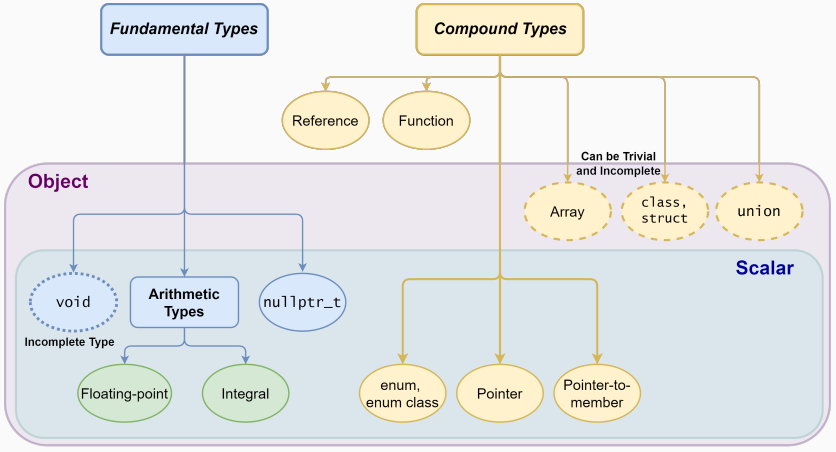
基础类型 (fundamental types)
- integral
| Native Type | Bytes | Range | Fixed width types <cstdint> |
|---|---|---|---|
| bool | 1 | true, false | |
| \(\operatorname{char}^{\dagger}\) | 1 | implementation defined | |
| signed char | 1 | -128 to 127 | int8_t |
| unsigned char | 1 | 0 to 255 | uint8_t |
| short | 2 | \(-2^{15}\) to \(2^{15}-1\) | int16_t |
| unsigned short | 2 | 0 to \(2^{16}-1\) | uint16_t |
| int | 4 | \(-2^{31}\) to \(2^{31}-1\) | int32_t |
| unsigned int | 4 | 0 to \(2^{32}-1\) | uint32_t |
| long int | \(4 / 8\) | int32_t/int64_t | |
| long unsigned int | \(4 / 8^*\) | uint32_t/uint64_t | |
| long long int | 8 | \(-2^{63}\) to \(2^{63}-1\) | int64_t |
| long long unsigned int | 8 | 0 to \(2^{64}-1\) | uint64_t |
注: * 4 bytes on Windows64 systems, \(\dagger\) signed/unsigned, two-complement from C++11 (二进制补码(Two's complement)是一种整数的二进制表示方法,广泛用于表示有符号整数。在二进制补码表示中,正数的表示与其无符号形式相同(符号位为 0),而负数是通过取其正数值的二进制反码(所有二进制位取反)然后加一得到的。)
查询大小:
# include <limits>
std::numeric_limits<int>::max(); // 2^31 − 1
std::numeric_limits<uint16_t>::max(); // 65,535
std::numeric_limits<int>::min(); // −2^31
std::numeric_limits<unsigned>::min(); // 0
- float
| Native Type | IEEE | Bytes | Range | Fixed width types |
|---|---|---|---|---|
C++23 <stdfloat> |
||||
| (bfloat16) | N | 2 | \(\pm 1.18 \times 10^{-38}\) to \(\pm 3.4 \times 10^{+38}\) | std::bfloat16_t |
| (float16) | Y | 2 | 0.00006 to 65,536 | std::float16_t |
| float | Y | 4 | \(\pm 1.18 \times 10^{-38}\) to \(\pm 3.4 \times 10^{+38}\) | std::float32_t |
| double | Y | 8 | \(\pm 2.23 \times 10^{-308}\) to \(\pm 1.8 \times 10^{+308}\) | std::float64_t |
float 类型的机器精度是 \(10^{-7}\), double 是 \(10^{-16}\)
# include <limits>
// T: float or double
std::numeric_limits<T>::max(); // largest value
std::numeric_limits<T>::lowest(); // lowest value (C++11)
std::numeric_limits<T>::min(); // smallest value
std::numeric_limits<T>::denorm min() // smallest (denormal) value
std::numeric_limits<T>::epsilon(); // epsilon value
std::numeric_limits<T>::infinity() // infinity
std::numeric_limits<T>::quiet NaN() // NaN
# include <cmath> // C++11
bool std::isnan(T value) // check if value is NaN
bool std::isinf(T value) // check if value is ±infinity
bool std::isfinite(T value) // check if value is not NaN
// and not ±infinity
bool std::isnormal(T value); // check if value is Normal
T std::ldexp(T x, p) // exponent shift x  2p
int std::ilogb(T value) // extracts the exponent of value
- 缩写
| Signed Type | short name |
|---|---|
| signed char | \(/\) |
| signed short int | short |
| signed int | int |
| signed long int | long |
| signed long long int | long long |
| Unsigned Type | short name |
|---|---|
| unsigned char | \(/\) |
| unsigned short int | unsigned short |
| unsigned int | unsigned |
| unsigned long int | unsigned long |
| unsigned long long int | unsigned long long |
- 后缀 (suffix)
| Type | SUFFIX | Example | Notes |
|---|---|---|---|
| int | \(/\) | 2 | |
| unsigned int | u, U | 3u | |
| long int | l, L | 8L | |
| long unsigned | ul, UL | 2ul | |
| long long int | ll, LL | 4ll | |
| long long unsigned int | ull, ULL | 7ULL | |
| float | f,F | 3.0f | only decimal numbers |
| double | 3.0 | only decimal numbers |
| C++23 Type | SUFFIX | Example | Notes |
|---|---|---|---|
| std::bfloat16_t | bf16, BF16 | 3.0bf16 | only decimal numbers |
| std::float16_t | f16, F16 | 3.0f16 | only decimal numbers |
| std::float32_t | f32, F32 | 3.0f32 | only decimal numbers |
| std::float64_t | f64, F64 | 3.0f64 | only decimal numbers |
| std::float128_t | f128, F128 | 3.0f128 | only decimal numbers |
- 前缀 (prefix)
| Representation | PREFIX | Example |
|---|---|---|
| Binary C ++14 | Ob | 0b010101 |
| Octal | 0 | 0307 |
| Hexadecimal | 0x or 0X | 0xFFA010 |
C++14 also allows digit separators for improving the readability 1'000'000
类型转换
\(\otimes\): any operation (*, +, /, -, %, etc.)
- Floating Point Promotion
- floating type \(\otimes\) integer type \(\rightarrow\) floating type
- Implicit Integer Promotion
- Rule: small integral type \(\otimes\) small integral type \(\rightarrow\) int
- 当两个小于
int类型的整数进行运算时,它们会被隐式提升为int类型,以确保有足够的位宽处理可能的数值扩展
- Size Promotion
- Rule: small type \(\otimes\) large type \(\rightarrow\) large type
- Sign Promotion
- Rule: signed type \(\otimes\) unsigned type \(\rightarrow\) unsigned type
- 当有符号类型和无符号类型一起运算时,为避免负值的意外产生,有符号类型会被转换为相应的无符号类型。这种转换是因为无符号类型有更宽的正数范围,而编译器尝试保证数值不会因为类型转换而变成负数。此时有符号的负数,比如 -2, 会转换为很大的无符号正数。
float f = 1.0f;
unsigned u = 2;
int i = 3;
short s = 4;
uint8_t c = 5; // unsigned char
f * u; // float × unsigned → float: 2.0f
s * c; // short × unsigned char → int: 20
u * i; // unsigned × int → unsigned: 6u
+c; // unsigned char → int: 5
int b = 7;
float a = b / 2; // a = 3 not 3.5!!
int c = b / 2.0; // again c = 3 not 3.5!!
auto
auto a = 1 + 2; // 1 is int, 2 is int, 1 + 2 is int!
// -> 'a' is "int"
auto b = 1 + 2.0; // 1 is int, 2.0 is double. 1 + 2.0 is double
// -> 'b' is "double"
auto g(int x) -> int { return x * 2; } // C++11
// "-> int" is the deduction type
// a better way to express it is:
auto g2(int x) -> decltype(x * 2) { return x * 2; } // C++11
// `decltype` 用于推导表达式的类型
auto h(int x) { return x * 2; } // C++14
//--------------------------------------------------------------
int x = g(3); // C++11
操作符 (operator)
| Precedence | Operator | Description | Associativity |
|---|---|---|---|
| 1 | a++ \(\quad\) a-- | Suffix/postfix increment and decrement | Left-to-right |
| 2 | +a \(\quad\) -a \(\quad\) ++a \(\quad\) --a \(\quad\) ! \(\quad\) not \(\quad\) ~ | Plus/minus, Prefix increment/decrement, Logical/Bitwise Not |
Right-to-left |
| 3 | a*b \(\quad\) a/b \(\quad\) a%b | Multiplication, division, and remainder | Left-to-right |
| 4 | a+b \(\quad\) a-b | Addition and subtraction | Left-to-right |
| 5 | << \(\quad\) >> | Bitwise left shift and right shift | Left-to-right |
| 6 | < \(\quad\) <= \(\quad\) > \(\quad\) >= | Relational operators | Left-to-right |
| 7 | == != | Equality operators | Left-to-right |
| 8 | & | Bitwise AND | Left-to-right |
| 9 | ^ | Bitwise XOR | Left-to-right |
| 10 | | | Bitwise OR | Left-to-right |
| 11 | && and | Logical AND | Left-to-right |
| 12 | || or | Logical OR | Left-to-right |
| 13 | += -= *= /= %= <<= >>= &= ^= |= | Compound | Right-to-left |
- The comma operator has left-to-right associativity. It evaluates the left expression, discards its result, and returns the right expression
int a = 5, b = 7;
 int x = (3, 4); // discards 3, then x=4
 int y = 0;
 int z;
 z = y, x; // z=y (0), then returns x (4)
显式类型转换
旧式类型转换:(类型) 值
新式类型转换:
- 静态转换(static_cast)执行编译时类型检查(而非运行时),这是最安全的转换方式,因为它防止了类型之间的意外或不安全的转换。
- 常量转换(const_cast)可以添加或去除(移除)常量性或易变性。
- 重解释转换(reinterpret_cast)?
reinterpret_cast<T*>(v) 等于 (T*) v
reinterpret_cast<T&>(v) 等于 *((T*) &v)
char a[] = {1, 2, 3, 4};
int* b = (int*) a; // ok
cout << b[0]; // print 67305985 not 1!!
//int* c = static_cast<int*>(a); // compile error unsafe conversion
const int a = 5;
const_cast<int>(a) = 3; // ok, but undefined behavior
sizeof
sizeof是一个编译时运算符,用于确定变量或数据类型的大小(以字节为单位)。sizeof返回一个size_t类型的值。sizeof(任何内容)永远不返回 0(*除了大小为 0 的数组)。sizeof(char)总是返回 1。- 当应用于结构体时,它还考虑到了内部填充。
- 当应用于引用时,结果是被引用类型的大小。
sizeof(不完全类型)会产生编译错误,例如void。sizeof(位域成员)也会产生编译错误。
sizeof(int); // 4 bytes
sizeof(int*) // 8 bytes on a 64-bit OS
sizeof(void*) // 8 bytes on a 64-bit OS
sizeof(size_t) // 8 bytes on a 64-bit OS
int f(int array[]) { // dangerous!!
cout << sizeof(array);
}
int array1[10];
int* array2 = new int[10];
cout << sizeof(array1); // sizeof(int) * 10 = 40 bytes
cout << sizeof(array2); // sizeof(int*) = 8 bytes
f(array1); // 8 bytes (64-bit OS)
struct A {
    int x; // 4-byte alignment
    char y; // offset 4
};
sizeof(A); // 8 bytes: 4 + 1 (+ 3 padding), must be aligned to its largest member
struct B {
    int x; // offset 0 -> 4-byte alignment
    char y; // offset 4 -> 1-byte alignment
    short z; // offset 6 -> 2-byte alignment
};
sizeof(B); // 8 bytes : 4 + 1 (+ 1 padding) + 2
struct C {
    short z; // offset 0 -> 2-byte alignment
    int x; // offset 4 -> 4-byte alignment
    char y; // offset 8 -> 1-byte alignment
};
sizeof(C); // 12 bytes : 2 (+ 2 padding) + 4 + 1 + (+ 3 padding)
char a;
char& b = a;
sizeof(&a); // 8 bytes in a 64-bit OS (pointer)
sizeof(b); // 1 byte, equal to sizeof(char)
// NOTE: a reference is not a pointer
struct S1 {
    void* p;
};
sizeof(S1); // 8 bytes
struct S2 {
    char& c;
};
sizeof(S2); // 8 bytes, same as sizeof(void*)
sizeof(S2{}.c); // 1 byte
